Everest Base Camp Trekking And Gokyo Lakes
25 Aug 2021

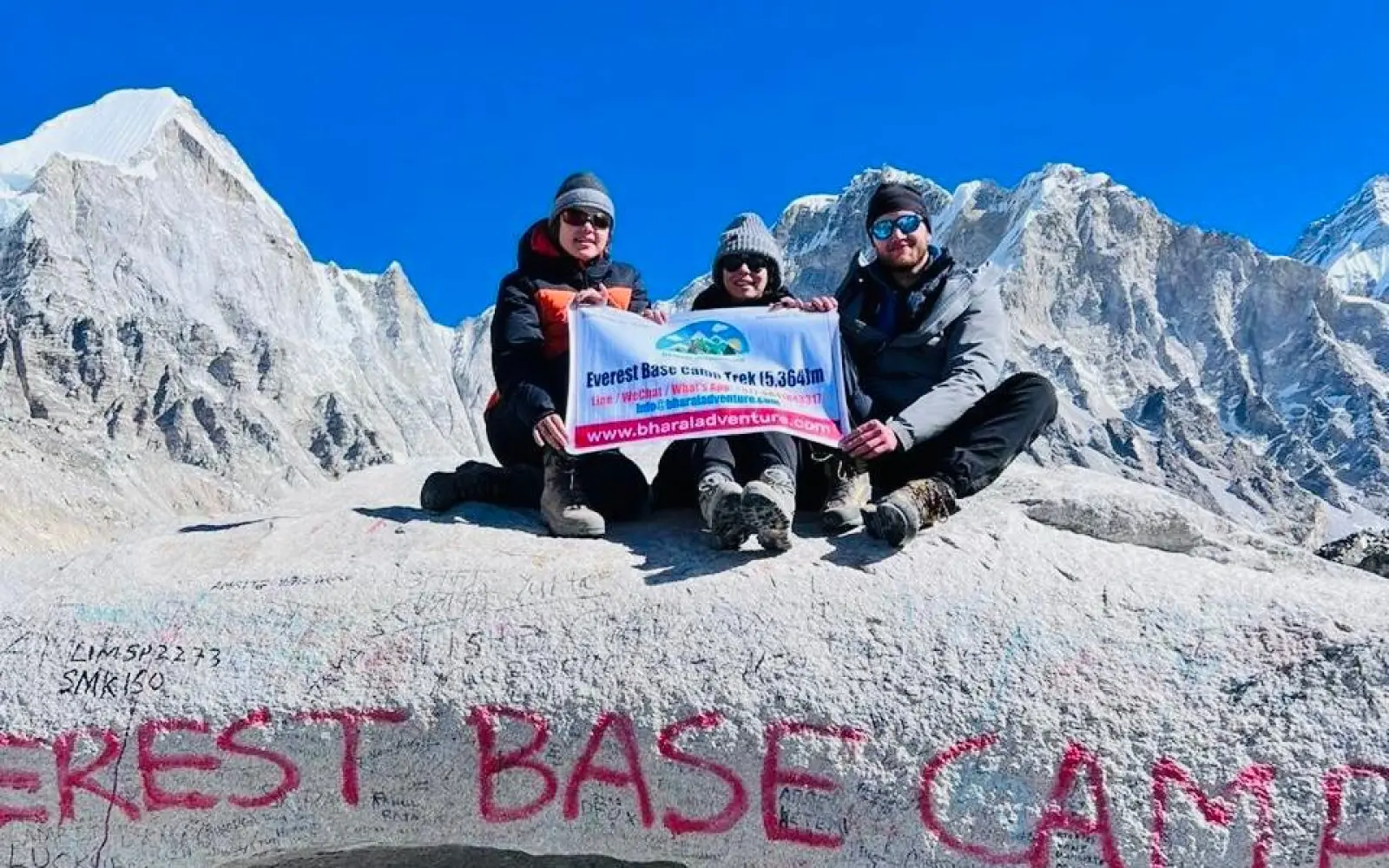
Everest Base Camp in Nepal is located at 5,364 meters (17,598 feet) above sea level. This is the commonly referenced elevation for the South Base Camp on the Nepal side of Mount Everest.
The Everest Base Camp elevation is measured on the Khumbu Glacier, where the surface changes as the glacier moves, thins, and shifts throughout the year. For this reason, the exact elevation recorded by a GPS device can vary by several meters depending on the season, snow conditions, and the precise location of the measurement. The 5,364-meter elevation is therefore used as the standard reference for Everest Base Camp in Nepal.
There are two Everest Base Camps, and they are not the same place.
The Everest South Base Camp in Nepal is located at an altitude of 5,364 meters (17,598 feet). When people ask what height Everest Base Camp is or how high Everest Base Camp is, they are usually referring to the South Base Camp. It is reached by a multi-day trek from Lukla through the Khumbu Valley.
The North Base Camp in Tibet is located at a lower elevation, at approximately 5,150 meters (16,900 feet) above sea level. Unlike the South Base Camp, it can be reached by road from the Tibetan side.
The exact altitude of Mount Everest Base Camp depends on which side of the mountain you are climbing:
Nepal (South) Base Camp: Located on the Khumbu Glacier, the Everest base camp Nepal elevation is exactly 5,364 meters above sea level.
Base Camp in Tibet (North): Located next to the Rangbuk Glacier, the Everest base camp Tibet altitude is 5,200 meters (17,060 feet) above sea level.
Everest Base Camp (South) in Nepal is located at an altitude of 5,364 meters (17,598 feet) above sea level, to be exact. The exact altitude of Mount Everest base camp, Nepal side is 5,364 meters above sea level, and this precise measurement gives an absolute Everest base camp height in ft of 17,598 feet.
Location: Khumbu Glacier, Solukhumbu District, Province 1, Nepal
Region: Sagarmatha National Park
Coordinates: 28°0'26'' North, 86°51'34'' East
Height: The Everest base camp height meters is 5,364 meters (17,598 feet)
The camp is located on a moraine adjacent to the Khumbu Glacier. As the glacier's ice is constantly moving, thinning and shifting throughout the year, its exact basecamp elevation varies by several metres depending on the seasonal movement of the ice. However, the international trekking industry, Global Navigation Systems and topographic mapping programs maintain the Everest base camp altitude 5364 m as the official reference point.
Compared to geographical landmarks around the world, the base camp height of Mount Everest is higher than the height of most major mountain peaks outside of Asia:
Mont Blanc (Europa): Located at an altitude of 5,298 meters, this campsite is 556 meters higher than the highest peak in the European Alps (4,808 meters).
Mount Whitney (United States of America): The camp is 943 meters higher than the highest mountain in the continental United States, which is 4,421 meters high.
At this historic rest stop, explorers rest in an alpine microclimate at an Everest altitude of more than 5.3 kilometers above sea level, requiring careful and planned physiological adaptations.
The geographical location of Mount Everest has two base camps on either side of the international border between Nepal and China. Understanding the differences in Everest camp elevations and logistics between these two destinations is essential for proper trip planning.
There are significant differences in altitude, terrain, and access methods when comparing the EBC base camp in Tibet to the Nepalese base camp. The Tibetan (northern) camp is slightly lower, at 5,150 metres (16,900 ft), while the Everest base camp south elevation is higher, at 5,364 metres (17,598 ft).
Mount Everest South Base Camp (EBC) in Nepal is located at a base camp elevation Everest of 5,364 meters above sea level, on the lateral moraine of the Khumbu Glacier.
Located here: Sagarmatha National Park in the Solukhumbu district.
Its exact geographical coordinates are as follows: 28°0′26″N 86°51′34″E
It is known as the most famous trekking destination in the world.
EBC is the initial training center for climbers climbing Everest via the Southern Col Road.
The traditional trek to the southern meeting point requires several days of trekking. The mountain range is situated on a highly mobile ice sheet, making the physical landscape variable with seracs and cracks.
Everest North Base Camp (EBC) is located in Tibet, China, where the Everest North Base Camp exact elevation is 5,150 meters (16,900 feet) above sea level at the foot of the mountain's north face.
Its exact coordinates are: 28°8′29″ North 86°51′5″ East.
Unlike the South Base Camp in Nepal, which requires a multi-day trek on foot, the North Base Camp in Tibet is very unique, completely accessible via an asphalt road, paved as it branches off from China National Highway 318. The destination is more popular for land vehicle travel than hiking.
Conversely, the northern option is located on the stable gravel bed of the Rangbuk Valley. Although located at a lower baseline than its Nepalese counterpart, easy vehicle access poses a hidden physical risk.
Driving up China's National Highway 318 disrupts the normal, slow acclimatization process, so if proper preparation is neglected at this Himalaya base camp height, the sudden drop in air pressure quickly becomes a difficult and demanding test of physical endurance.
The table below details the main stops on the classic Everest Base Camp route, ordered from the lowest point on the route to the highest Himalayan peak:
| Landmark Trail Station | Height in meters (m) | Height in feet (ft) | Altitude in kilometers (km) |
|---|---|---|---|
| Kala Pathar view | 5,545 meters | 18,192 ft | 5.545 kilometers |
| Everest South Base Camp (Nepal) | 5,364 meters | 17,598 ft | 5.364 kilometers |
| Flat Area in the Shape of a Gorak (Gorak Shep) | 5,164 meters | 16,942 ft | 5.164 kilometers |
| Everest North Base Camp (Tibet) | 5,150 meters | 16,900 ft | 5.150 kilometers |
| Lobuche | 4,940 meters | 16,207 ft | 4.940 kilometers |
| Dingboche Valley Area | 4,410 meters | 14,468 ft | 4.410 kilometers |
| Tengboche Monastery | 3,860 meters | 12,664 ft | 3.860 kilometers |
| Namche Bazaar Sherpa Capital | 3,440 meters | 11,290 ft | 3.440 kilometers |
| Start of the route from Lukla Airport | 2,860 meters | 9,383 ft | 2.860 kilometers |
The official elevation of Everest Base Camp South (Nepal) is 5,364 metres (17,598 ft) above sea level, making 5364 m in feet exactly 17,598. In standard global positioning systems, this elevation is approximately 5.364 kilometres (3.333 mi) directly above.
| Base camp location | Meter (m) | Feet (ft) | Kilometer (km) | Mile (mi) |
|---|---|---|---|---|
| South Base Camp (Nepal) | 5,364 | 17,598 | 5.364 | 3.333 |
| North Base Camp (Tibet) | 5,150 | 16,900 | 5.150 | 3.200 |
The Everest Base Camp Trek elevation temperature drops during long treks, and a significant physical change begins as the path enters the upper troposphere. The journey begins with a high-altitude flight landing at Lukla Airport, located at an altitude of 2,860 meters.
The total elevation gain between Lukla and the final camp is 2,504 meters. However, the total EBC trek height gained is much higher due to the winding nature of the route. The mountain route often descends into deep river valleys before ascending steep peaks, resulting in a total elevation gain of between 3,500 and 4,000 meters during the ascent to the Everest base camp elevation 5364 m.
This traditional route to Everest Base Camp is a grueling 130-kilometer (80-mile) circular trek. Climbers typically trek 10-15 kilometers (6-9 miles) each day, braving the thinning atmosphere and enduring 5-7 hours of grueling physical labor per shift.
This grueling 12-14 day trek strategically places necessary rest stops to acclimatize to the weather and prevent severe altitude sickness (hypoxia). It makes a continuous ascent from Lukla (2,860m) to the frozen world of EBC (5,364m), and finally reaches the stunningly beautiful peak of Kala Pathar (5,545m).
The highest and most iconic point on the Mt Everest base camp classic trek is the Kala Pathar viewpoint. At an altitude of approximately 5,540 to 5,545 meters, it rises above the Gorak Shep location.
To choose an international trekking destination, one must compare the specific altitude characteristics and physical demands of popular routes.
The summit of Mount Kilimanjaro is higher than both of Everest's base camps. Kilimanjaro's summit is 5,895 metres (19,341 ft), which is 531 metres higher than Everest's South Camp in Nepal and 745 metres higher than Everest's North Camp in Tibet.
| Metric height | Mount Kilimanjaro (peak) | Everest South Base Camp (Nepal) | Everest North Base Camp (Tibet) |
|---|---|---|---|
| Official height | 5,895 meters (19,341 ft) | 5,364 meters (17,598 ft) | 5,150 meters (16,900 ft) |
| Oxygen levels | 49% of sea level | 53% of sea level | 55% of sea level |
| Target type | Mountain peak / summit | Glacier Valley / Camping | Plateau Valley / Campsite |
| Maximum ride height | 5,895 meters (Uhuru Peak) | 5,545 meters (Kala Pathar Peak) | 5,150 meters (Main Camp Road) |
Everest Base Camp, Annapurna Circuit/Base Camp and Manaslu offer a wide range of trekking options and altitudes. While Everest Base Camp is a round trip trek to a high altitude glacial basin, Annapurna and Manaslu are legendary circular circuits that traverse high mountain passes.
The Annapurna Base Camp trek has a maximum elevation of 4,130 meters, making it a shorter, warmer, and physically easier option, and also carries a much lower risk of altitude sickness compared to the Mt Everest base camp elevation in feet. The Annapurna Circuit is slightly higher than the elevation of EBC, which is at an elevation of 5,416 meters.
The Manaslu Circuit Trek enters a remote wilderness area, reaching an altitude of 5,160 meters at the summit of the Larke La pass.
| Features | Everest Base Camp (EBC) | Annapurna Circuit / ABC | Manaslu Circuit |
|---|---|---|---|
| Maximum height | 5,364 m (Base Camp) / 5,545 m (Kala Pathar) | 5,416 m (Thorong La mendatea) / 4,130 m (ABC) | 5,106 meters (Larkia La pass) |
| Trek structure | Round trip | Circular loop (circuit) or inside-out valley (ABC) | Circular route around Mount Manaslu |
| Crowd level | High / Commercial | Upper (Lower) Intermediate | Low/Limited and Remote |
| Directions | If you have a TIMS card, you can work independently. | Some routes are allowed to work independently (on local shifts only). | Guide required (reserved area) |
| Housing | Tea shops from luxury to average quality | Advanced tea house | A simple but fast-growing tea shop |
The main obstacle to traveling at high altitudes is the change in atmospheric physics. As Everest altitude increases, the absolute percentage of oxygen molecules in the air remains constant at around 21%, but the decrease in atmospheric pressure causes these air molecules to disperse further.
At sea level, the ideal atmospheric pressure is 1,013 millibars, which provides 100% oxygen concentration to the lungs. At Everest Base Camp in Nepal, at an elevation of Mount Everest base camp of 5,364 meters, the atmospheric pressure drops to around 540 millibars. This reduction means that 50% of the oxygen available at sea level is consumed with each breath, forcing the heart and lungs to work twice as hard to maintain normal oxygen levels in the blood.
Everest Base Camp (South) in Nepal is officially at an altitude of 5,364 meters (17,598 feet) above sea level. Looking at another route, the base of Everest elevation in northern Tibet is slightly lower, at an altitude of about 5,150 meters (16,900 feet).
Mount Everest Base Camp is located at two completely different altitudes, depending on which side of the mountain you are heading. If you take the classic South Base Camp route in Nepal, you will reach an Everest base camp elevation height of 5,364 meters.
On the other hand, if you go to the North Tibetan Base Camp, it is slightly lower, with an EBC elevation in feet of 16,900 feet (5,150 meters).
The total elevation gain from Lukla airport to base camp is 2,504 meters. However, as the trail climbs ridges and descends to riverbanks, the total elevation gain is between 3,500 and 4,000 meters to reach the final Everest base camp altitude 5364.
The main question for aspiring mountaineers is whether beginners can successfully complete the 5,364-meter (17,700-foot) trek. The Everest Base Camp trek is classified as follows: Moderate or tiring.
No technical skills are required. The normal route does not require crampons, ice axes or rope work. The path to the base camp is a pedestrian path and most of it is well maintained.
The typical trek to Everest Base Camp takes between 12 and 14 days. Starting from Kathmandu, it takes 9-10 days to climb to the base camp of Mount Everest height and 3-4 days to descend. During this time, acclimatization days are needed to avoid altitude sickness.
At Everest Base Camp (5,364 meters / 17,598 feet), the atmospheric pressure is much lower than at sea level. The air still has 21% oxygen, but reduced pressure means it is only about 50% of the available oxygen in your lungs and blood compared to sea level.
Atmospheric pressure drops to 540 millibars, so walking at a slow pace is necessary for the body to adapt to the elevation of EBC.
Nepal. The mount Everest south base camp elevation is at an altitude of 5,364 meters (17,598 feet). The northern base camp in Tibet is at an altitude of 5,200 meters (17,060 feet). This means that the altitude difference is 164 meters.
The difference in altitude is true, but that's not the most interesting difference between the two camps. What really sets them apart is the method of getting there. It takes 9-10 days to hike from the Khumbu Valley on the Nepal side. On the Tibetan side, there is a paved road that goes directly to the camp, meaning you can reach the base of Everest elevation in a day by car from the lower Tibetan villages.
Technically, no. The medical classification of extreme altitude begins at 5,500 meters. EBC, at 5,364 meters, falls into the very high altitude category, which is 136 meters below that limit.
But this hierarchical distinction doesn't mean your body takes it easy. Above 5,000 meters, almost everyone experiences some physical effects, whether it's constant headaches, irregular sleep, loss of appetite, or a significant loss of energy. This explains why many wonder how common is Everest base camp altitude sickness. The human body is not designed to live at such altitudes. It adapts over time, but it doesn't feel comfortable in this environment.
No. Oxygen tanks are primarily for climbers going much higher, ascending from the Everest base camp to summit elevation, which is above 7,000 and 8,000 meters, not for trekkers who walk to base camp.
Your body can handle the 5,364-meter altitude better than most people expect, if you give it enough time to acclimatize. That’s the main goal of this 12-14-day trek. The altitude acclimatization days in Namche Bazaar and Dingboche are not rest days like tourists. During these days, your blood quietly does its work, producing more red blood cells to carry more oxygen with each breath.
Some hikers carry a small pulse oximeter along the way to check their blood oxygen levels. It's a handy thing to carry. But not an oxygen tank.
The number is 5,364 meters. Now you know what it means, how it feels physically, and what the path to get there is like.
If you’re ready to book, Bharal Adventures organizes guided treks to Everest Base Camp with Sherpa guides from the Khumbu region and a weather-adapted itinerary. You can contact them directly for dates, group sizes, permits, and costs.
For most people, the next step after reading is to compare routes and ask questions. And that's exactly what the group is for.

The Everest Base Camp (EBC) Trek is one of the world's most famous trekking adventures. Located in the Khumbu region of Nepal, this trek takes you to...
The Everest Base Camp (EBC) Trek is one of the world's most famous trekking adventures, attracting thousands of trekkers to Nepal every year. Located...
